
Overview | Key Findings
A quick overview
- Canada has strong innovation assets—like top-tier research institutions and a skilled workforce—but struggles to convert these into productivity and high-impact innovation.
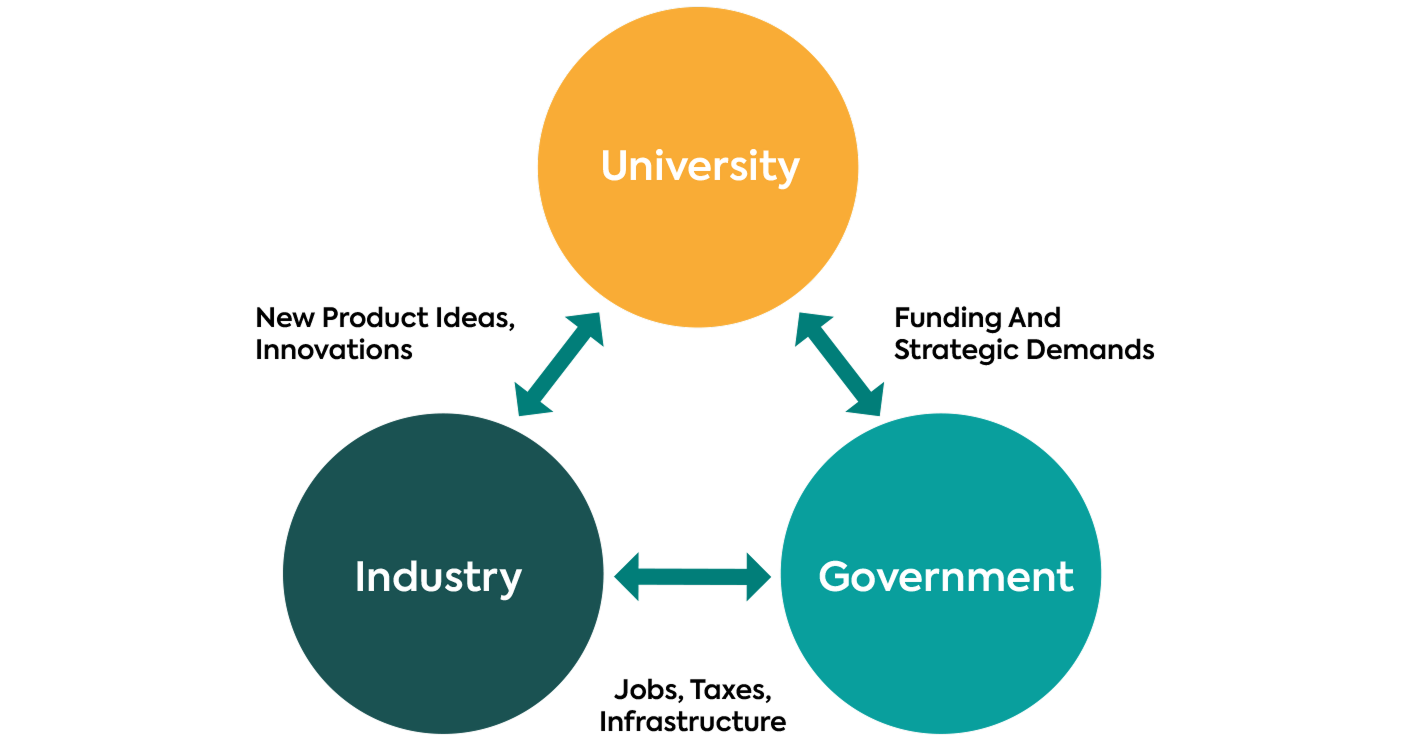
- The Triple Helix model, which promotes collaboration between government, academia, and industry, offers a strategic framework to better align efforts and support innovation-driven growth.
- Public-Private Partnerships (PPPs) in Canada need reform; current approaches are often fragmented and lack feedback loops, coordination, and long-term vision.
- Global examples from Germany, Denmark, and Singapore show how structured innovation clusters and state-supported coordination can lead to stronger commercial outcomes and global competitiveness.
- Canada’s path forward includes adopting mission-based innovation clusters, boosting translational research, modernizing procurement, and treating innovation as foundational infrastructure—not just policy.
Overview | The Translation Problem
Introduction
Our past studies have shown that Canada possesses substantial innovation assets, including a well-educated workforce, globally recognized research institutions, and a wealth of natural and technological resources. Yet, despite this strong foundation, the country continues to face structural challenges in translating these inputs into sustained, high-impact innovation as well as a higher yield in productivity.
Framework | Triple Helix
What Is the Triple Helix Model and Why It Matters for Canada’s Innovation Ecosystem
The Triple Helix model, which emphasizes systemic collaboration among government, academia, and industry, presents a promising framework to address this gap. Countries such as Germany, Denmark, and Singapore have embraced this approach to strengthen innovation ecosystems through tightly coordinated public-private partnerships (PPPs), mission-driven research, and institutional innovation clusters. Canada has opportunities to learn from and adapt these strategies to better align public and private efforts, support knowledge translation, and increase national innovation capacity.
Framework | PPP Reform
The Role of Public-Private Partnerships in Innovation Ecosystems
While Canada maintains numerous PPPs across research and technology domains, many are siloed, underfunded, or limited in long-term coordination. Current models often lack formal structures for feedback, performance measurement, or policy alignment.
To improve outcomes, PPPs should evolve beyond project-based collaboration into platforms for shared experimentation, risk mitigation, and applied problem-solving. This includes:
Sector-Specific Innovation Clusters
Developing sector-specific innovation clusters that coordinate public research, privateinvestment, and civil society actors. The framework and infrastructure must be set up so industriescan achieve this; regulatory alignment will be a step in the right direction.
Feedback Mechanisms for Responsive Policy
Embedding feedback mechanisms to ensure that innovation policy is responsive to both marketsignals and public interest. More incentives exist, with private companies leading the charge anddriving the cluster forward.
Academic Grants for Translational Institutions
Creating academic grants tailored towards supporting translational institutions that help bridgethe gap between basic research and applied, market-ready solutions.

Moreover, some policy tools commonly used to incentivize innovation, such as patent boxes have had mixed results. While effective in rewarding intellectual property ownership, these measures often benefit established firms with advanced legal and R&D capabilities without necessarily fostering inclusive or collaborative innovation ecosystems. As such, they may be better positioned as complementary to—rather than replacements for—more holistic and participatory models of innovation governance.
Benchmark | Global Models
International Models of Triple Helix and Cluster Implementation
Several jurisdictions have developed mature Triple Helix systems that can serve as models for Canada. Their experience demonstrates that innovation thrives when institutional collaboration is formalized, targeted, and supported by strategic coordination. The goal is not necessarily to follow the exact formula implemented by our global peers but to focus on creating a system that allows us to increase our productivity as a nation.
Benchmark | Germany
Germany: Applied Research Through Fraunhofer Institutes
Germany’s Fraunhofer Institutes represent a globally respected applied research model that directly serves the industry’s needs. Funded through a combination of public and private sources, the institutes work closely with small and medium-sized enterprises (SMEs) to develop new technologies, prototypes, and industrial applications. This model has contributed significantly to Germany’s global leadership in high-value manufacturing and engineering innovation [1].
Benchmark | Denmark
Denmark: Global Co-Innovation via Innovation Centres

Italy has seen a transformation in R&D investment over recent years. In 2016, Italy’s gross domestic expenditure on R&D (GERD) hit €23.2 billion, marking a 4.6% increase from the previous year (OECD, 2023). However, R&D intensity was only 1.38%, below the EU average, largely due to declining investment by Italy’s largest firms. Encouragingly, SMEs have increased R&D spending, helping to stabilize the country’s overall R&D performance.
Benchmark | United Kingdom
United Kingdom's R&D Investments
Denmark supports a network of Innovation Centres that facilitate collaboration between Danish universities, startups, and global partners. These centres function as soft landing zones for international co-innovation, allowing Danish companies to access global research networks while exporting domestic expertise in fields such as renewable energy, biotechnology, and health technology [2].
Benchmark | Singapore
Singapore: State-Led Innovation Coordination
Singapore’s innovation system is built on high levels of state coordination, with government agencies such as A*STAR (Agency for Science, Technology and Research) playing a central role. These agencies actively broker partnerships between universities, multinational corporations, and startups, ensuring alignment between national priorities and research agendas. This structure has supported Singapore’s leadership in urban innovation, health technology, and industrial R&D [3].
Analysis | The Path Forward
Canada’s Current Landscape and Opportunities for Reform
The goal is not merely to increase funding but to align incentives and clarify roles within the innovation ecosystem. The Triple Helix model provides a practical framework for doing so, with the potential to deliver more coherent and outcomes-focused innovation strategies. Compared to Germany, Denmark, and Singapore, Canada’s approach to innovation collaboration tends to be broader in scope but less structured and less targeted. While existing programs aim to balance regional equity, academic excellence, and economic competitiveness, this wide mandate can dilute impact.Canada’s innovation programs are less focused and structured than those of some other countries, which can lessen their impact.
To improve outcomes, Canada should create mission-based innovation clusters, fund applied research centres focused on commercialization, prioritize long-term partnerships, modernize public procurement, and establish common evaluation frameworks.
Summary | Key Takeaways
Conclusion: Innovation as Infrastructure
Innovation should not be treated as a discrete policy area. It is foundational infrastructure, essential for economic competitiveness, public health, environmental resilience, and inclusive growth. The Triple Helix model, when effectively implemented, provides the institutional scaffolding needed to build a more coordinated, adaptive, and forward-facing innovation system. Canada has the intellectual capital, research depth, and policy imagination to realize this vision. By deepening collaboration across sectors and investing in shared platforms for innovation, the country can transform its existing strengths into a sustainable, system-wide advantage.
References | Data Sources
Sources
- [1] Fraunhofer-Gesellschaft. (2023). “Fraunhofer at a Glance.”
- [2] Ministry of Higher Education and Science, Denmark. (2023). “Innovation Centres Denmark.”
- [3] ASTAR – Agency for Science, Technology and Research, Singapore. (2023). “About ASTAR.”
#ResearchAndDevelopment #Innovation #EconomicGrowth #Canada #Productivity #GlobalCompetitiveness
