
AI | Core Concepts
A quick overview
- Canada has played a key role in shaping modern AI, particularly in deep learning, machine learning, and ethical AI research.
- Geoffrey Hinton co-created AlexNet and helped launch Canada’s deep learning ecosystem, later joining Google and advocating for ethical AI.
- Yoshua Bengio founded MILA and advanced NLP techniques that underpin models like GPT and BERT, cementing Canada’s global AI reputation.
- Richard Sutton transformed reinforcement learning, enabling AI to learn through trial and error—impacting robotics, gaming, and automation.
- Institutions like MILA, Amii, and the Vector Institute have made Canada a global hub for AI talent, research, and innovation.
Overview | Canada's AI Legacy
Introduction
Over the years, Canada has played a pivotal role in shaping artificial intelligence, laying the groundwork for groundbreaking research and establishing world-class AI institutions. With government-backed investments, a thriving tech ecosystem, and an unmatched talent pool, Canada’s influence on AI continues to grow- a legacy set in motion by the country’s own AI founding fathers.
Canada’s AI contributions have been most notable in deep learning, machine learning, and ethical AI research- fields that have completely redefined how machines interact with the world. These advancements wouldn’t have been possible without the pioneering work of Canadian researchers whose discoveries transformed AI from theory into reality.
People | The Pioneers
The Pillars of AI: The Canadian Minds That Made It Happen
These researchers challenged conventional thinking and revolutionized artificial intelligence with their insights into deep learning, neural networks, and reinforcement learning. Their breakthroughs led to the AI-powered tools and technologies we use every day, from chatbots and recommendation algorithms to autonomous systems and voice assistants.
Pioneer | The Godfather Of AI
Geoffrey Hinton
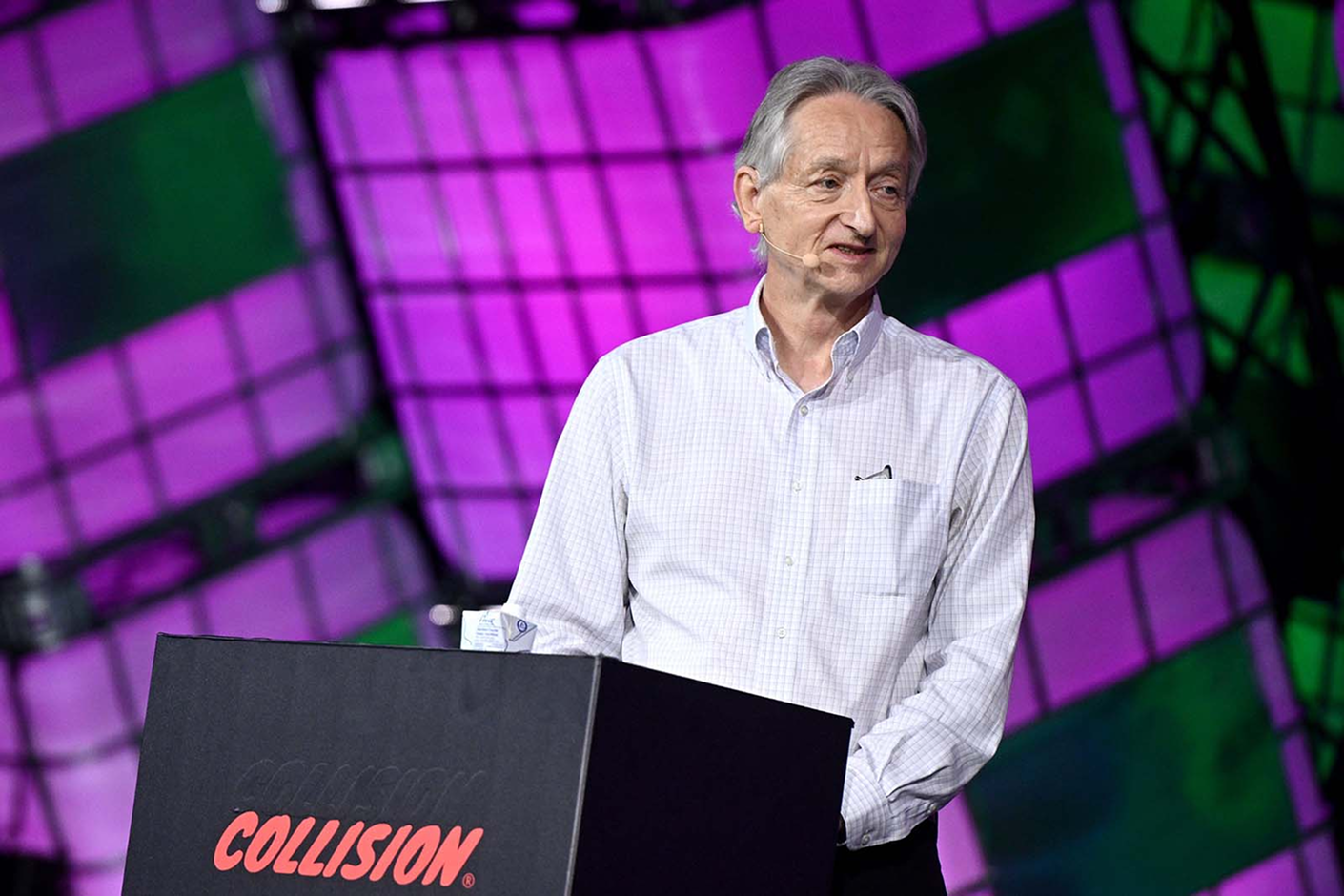
Photo by Collision Conf© Collision Conf, used under CC BY 2.0. No changes made.
Journey | Deep Learning Origins
Early Life & the Birth of Deep Learning
Born to Howard Everest Hinton, an accomplished entomologist, Geoffrey Hinton was destined for academic success. His family tree included several intellectual greats- Charles Howard Hinton, a mathematician famous for visualizing higher dimensions; George Everest, the surveyor after whom Mount Everest is named; and George Boole, the originator of Boolean logic, which serves as the basis of modern computing.
Geoffrey Hinton started with a degree in experimental psychology from Cambridge, then took a deep dive into AI at Edinburgh, where he explored neural networks mimicking human brain activity. His postdoc at UC Berkeley pushed him further into this field. Later, at Carnegie Mellon, he teamed up with David Rumelhart and Ronald J. Williams to co-develop backpropagation, the game-changing algorithm that powers modern deep learning. By enabling neural networks to fine-tune themselves through gradient descent, backpropagation became the foundation of today’s AI revolution.
Journey | Toronto Years
Building Canada’s Deep Learning Hub
In 1987, driven by his opposition to U.S. military funding and the Reagan administration, Hinton left the United States for Canada. As a professor at the University of Toronto (U of T), he continued his research for 11 years before taking a leadership position at the Gatsby Computational Neuroscience Unit at University College London in 1998. Returning to U of T in 2001, he further advanced neural network models and began exploring their practical applications, leading directly to the rise of deep learning technology.
Impact | AlexNet & Ethics
From AlexNet to AI Ethics: Hinton’s Lasting Impact
In 2012, alongside his graduate students Alex Krizhevsky and Ilya Sutskever, Hinton created AlexNet, an eight-layer neural network designed to classify images from ImageNet, a massive online image database. AlexNet was a turning point for AI research, leading Hinton and his team to establish DNNresearch, which Google acquired in 2013 for $44 million. Hinton subsequently joined Google Brain, serving as a Vice President and engineering fellow.
In May 2023, Hinton stepped down from Google to speak openly about the potential risks of AI, citing concerns about misinformation and the impact of automation on the job market.
Throughout his career, Hinton has received multiple prestigious awards, including the David E. Rumelhart Prize (2001) and Canada’s highest honor for science and engineering, the Gerhard Herzberg Canada Gold Medal (2010). In 2018, he was awarded the Turing Award, often referred to as the “Nobel Prize of Computing,” for his revolutionary work on neural networks. His impact on deep learning was further recognized in 2022 when he received the Royal Society’s Royal Medal for his pioneering advancements in AI.
Pioneer | The Architect Of NLP
Yoshua Bengio
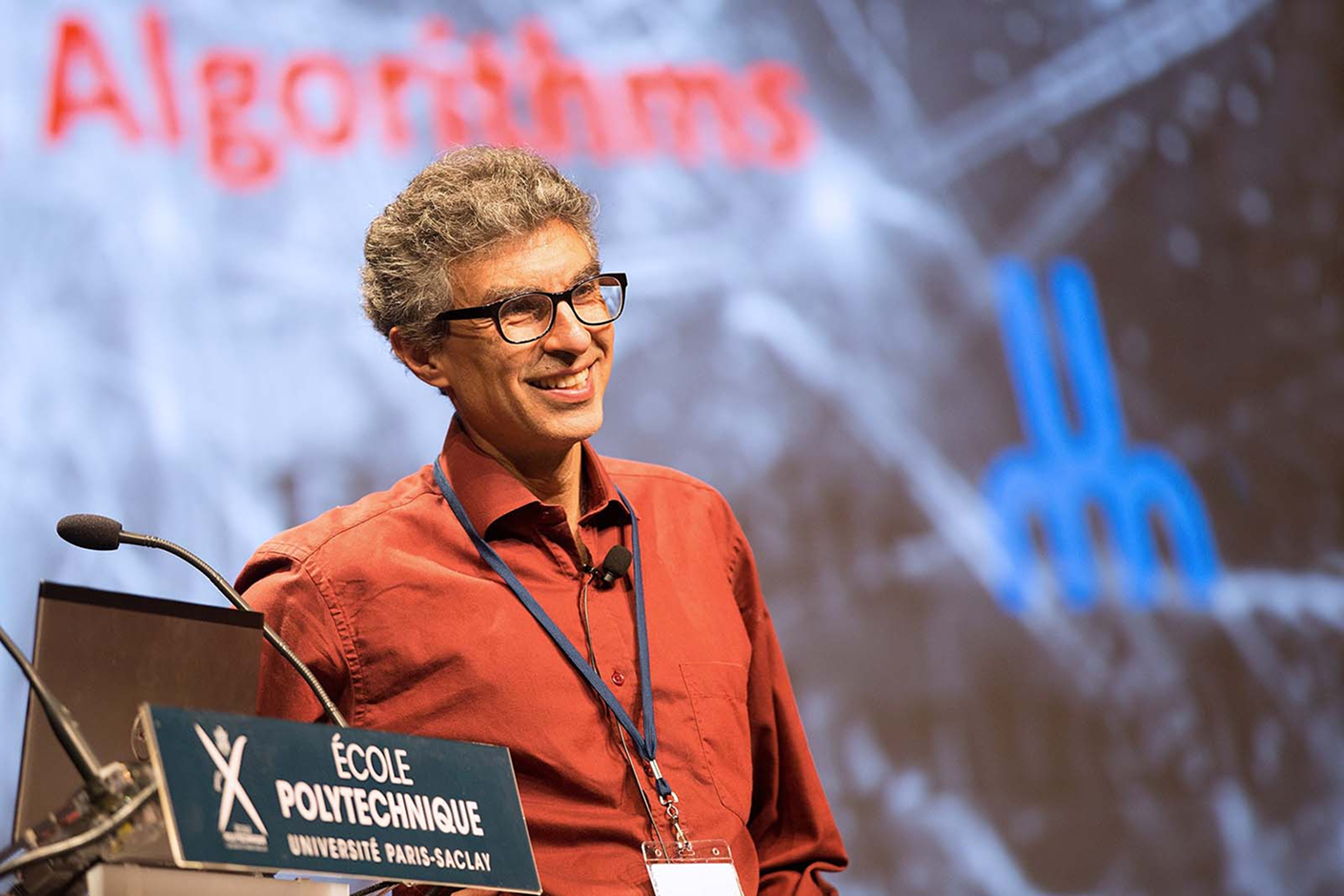
Photo of Yoshua Bengio by the International Telecommunication Union, licensed under CC BY 2.0. Source. No changes made.
Journey | Montreal Roots
Early Life & the Foundation of a Vision
Originally of Moroccan-Jewish descent, Yoshua Bengio moved to Canada when he was young, immersing himself in a world of curiosity and scholarship. He pursued a career in computer science, completing his bachelor’s, master’s, and Ph.D. at McGill University.
Bengio’s research into artificial neural networks began in the early 1990s, a time when the idea was widely dismissed. However, he remained convinced that machines could learn in ways that mimicked human cognition. After completing his Ph.D. in 1991, Bengio worked as a postdoctoral researcher at MIT before returning to Canada in 1993 to join the Université de Montréal.
During this period, Bengio explored representation learning, a concept that helped AI models develop internal representations of language, images, and data. His research into word embeddings became a cornerstone of natural language processing, enabling AI to understand relationships between words in context. His work also contributed to sequence-to-sequence learning, laying the foundation for transformer-based models, the architecture behind OpenAI’s GPT models and Google’s BERT.
Impact | MILA & Turing Award
MILA, Deep Learning, and Global Impact
In 1993, Bengio founded MILA (Montreal Institute for Learning Algorithms), which has since evolved into one of the world’s leading AI research institutes. Under his leadership, MILA became a global AI powerhouse, driving advancements in deep learning, NLP, and ethical AI. His contributions placed Canada at the forefront of AI research, alongside the Vector Institute in Toronto and the Alberta Machine Intelligence Institute in Edmonton.
In 2018, Bengio, alongside Hinton and Yann LeCun, received the Turing Award for their groundbreaking work in deep learning. Today, he remains one of AI’s leading voices, advocating for responsible AI development and regulation.
Pioneer | Reinforcement Learning
Richard Sutton
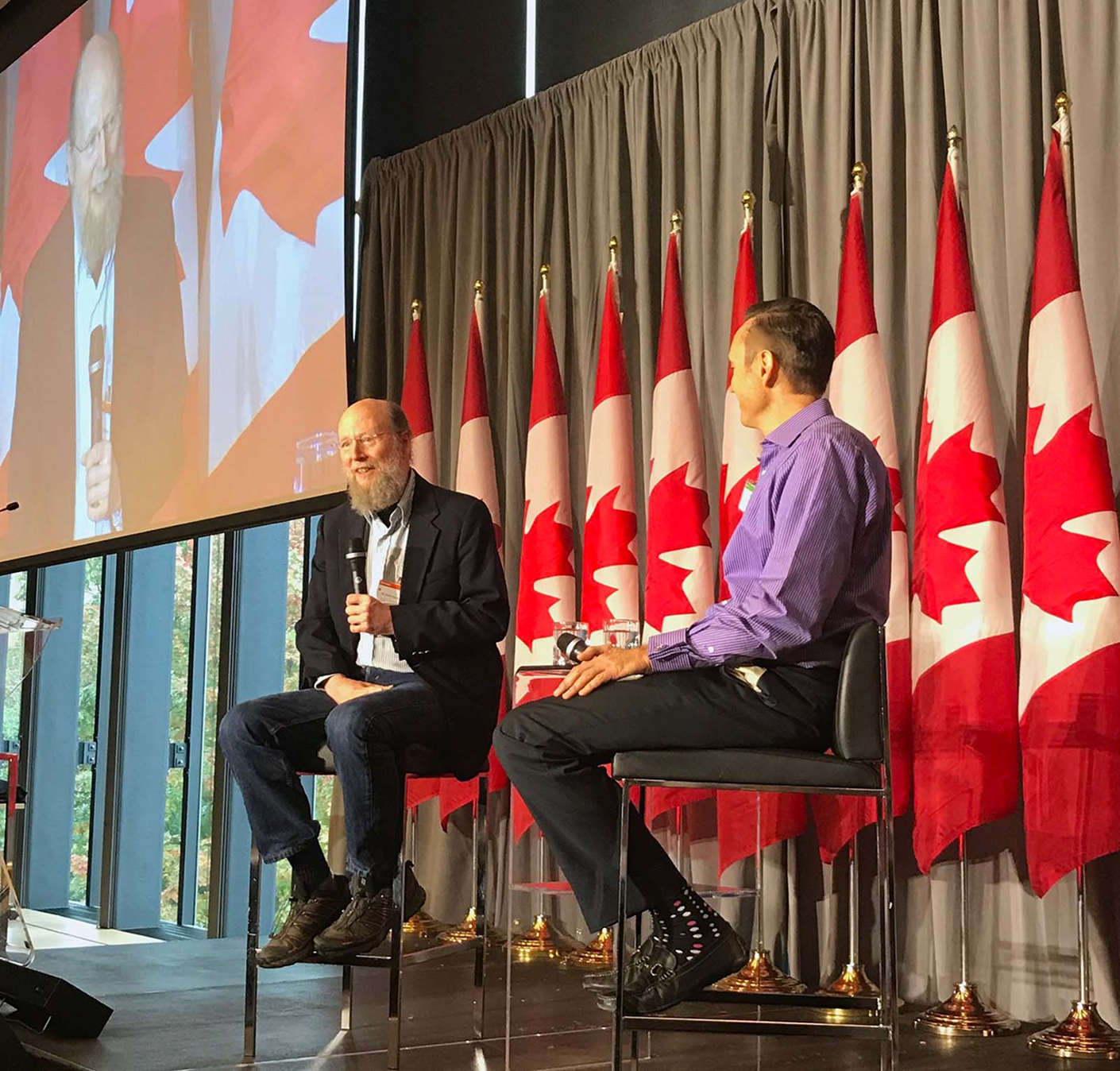
Photo by Steve Jurvetson,licensed under CC BY 2.0. Source. No changes made.
A recognized authority in the world of AI, Richard Sutton has made enormous contributions to AI, particularly in reinforcement learning. His Temporal Difference Learning algorithm transformed how machines refine predictions, influencing robotics, automation, and game AI. According to Lark’s AI glossary, Temporal Difference Learning involves the process of updating predictions based on the current and future values of rewards. With a focus on prediction errors, the algorithms modify their predictions as new information becomes available, leading to enhanced decision-making capabilities in AI systems.
After completing his Ph.D., Sutton worked at GTE Laboratories and AT&T Bell Labs before moving to Canada in 2003. There, he helped found Amii (Alberta Machine Intelligence Institute), turning Edmonton into a global hub for reinforcement learning research. His book,Reinforcement Learning: An Introduction, remains the definitive text on the subject.
Sutton’s work has shaped AI-driven decision-making in industries ranging from autonomous vehicles to predictive analytics. His essay, “The Bitter Lesson”, reinforced his belief that AI advances best through scale and computational power rather than handcrafted human rules. In 2024, Sutton was honored with the Turing Award alongside Andrew Barto for his contribution to reinforcement learning.
Summary | Key Takeaways
Conclusion
Canada’s influence on AI is undeniable. With a strong foundation in research, world-class institutions, and pioneering minds, the country continues to shape the future of artificial intelligence. As AI evolves, so does the need for ethical considerations and responsible development. Where does Canada’s AI leadership go next? The conversation is just getting started.
References | Data Sources
SourcesGeneral AI History & Canada's Role
- CIFAR. (n.d.). Pan-Canadian Artificial Intelligence Strategy
- Government of Canada. (2017). Budget 2017: Innovation and Skills Plan
- Forbes. (2023). Canada’s Role in Global AI Leadership
Geoffrey Hinton
- Schmidhuber, J. (2015). Deep Learning in Neural Networks: An Overview. Neural Networks, 61, 85–117.UK Patent Box Regime – gov.uk
- University of Toronto News. (2023). Geoffrey Hinton Resigns from Google to Speak on AI Risks
- Wired. (2018). The Three Godfathers of AI and Their Path to the Turing Award
- The Royal Society. (2022). Royal Medal: Geoffrey Hinton
Yoshua Bengio
- MILA (Montreal Institute for Learning Algorithms)
- Bengio, Y. (2009). Learning Deep Architectures for AI. Foundations and Trends in Machine Learning
- Turing Award Announcement. (2018). For Deep Learning Contributions. ACM
- McGill University. (n.d.). Alumni Profiles: Yoshua Bengio
Richard Sutton
- Sutton, R.S., & Barto, A.G. (2018). Reinforcement Learning: An Introduction (2nd ed.). MIT Press.
- Amii (Alberta Machine Intelligence Institute)
- Sutton, R. (2019). The Bitter Lesson
- The Royal Society. (2022). Royal Medal: Geoffrey Hinton
- Turing Award Press Release (2024). Recognition for Sutton and Barto’s Reinforcement Learning Research
Supporting Concepts & Ethics
- Nature. (2015). Deep Learning
- AI Now Institute. (2022). AI Ethics and Governance Annual Report
- UNESCO. (2021). Recommendation on the Ethics of Artificial Intelligence
#CanadaResources #EconomicData #SRandED #InnovationInIndustry #NaturalResourceEconomy #CleanEnergyCanada #ResourceStrategy #CheckpointResearch #ProvincialEconomy #IndustrialCanada #MiningToHydro
