
Economy | Core Concepts
A quick overview
- Canada’s economy isn’t monolithic; each province and territory is powered by distinct sectors such as oil, agriculture, mining, finance, and tech
- Nationally, services account for ~70% of GDP, but provinces like Alberta (oil) or Saskatchewan (agriculture) tell a very different story.
- Natural resources dominate in Alberta, Newfoundland & Labrador, and B.C., while mining is key in the North and parts of Quebec and Saskatchewan.
- Agriculture plays a vital role in Manitoba, Saskatchewan, and PEI, both economically and in terms of global food exports.
- Services and innovation drive Ontario, Quebec, and B.C. with sectors like finance, aerospace, AI, tourism, and tech reshaping growth.
- Emerging trends like climate transition, Indigenous-led development, and clean energy are redefining provincial roles in Canada’s economic future.
Overview | Regional Economies
Introduction
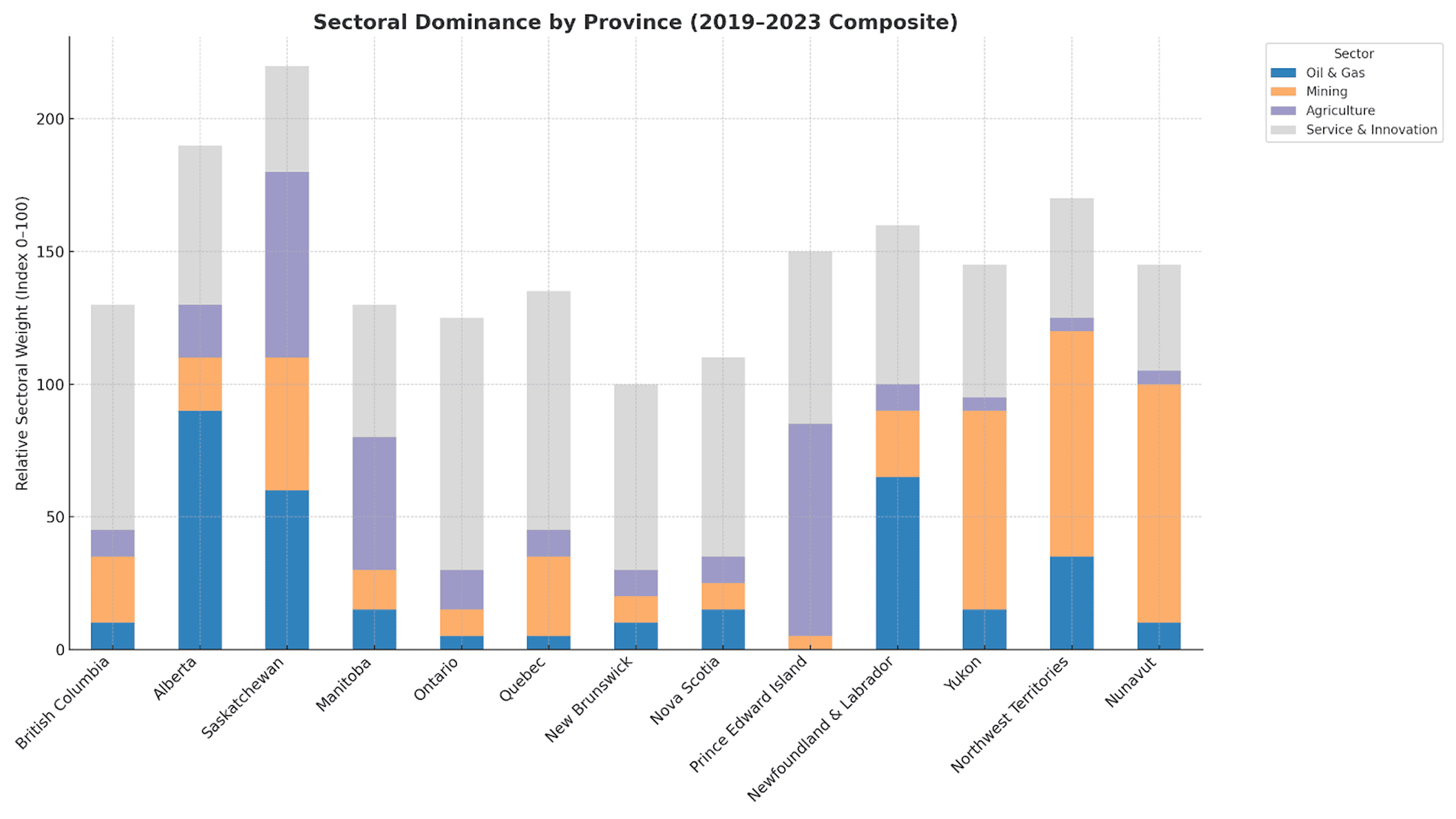
Canada is not a monolith; it is a federation of distinct regional economies, each shaped by geography, resources, and legacy industries. From the oil sands of Alberta to the high-tech corridors of Ontario, each province and territory contributes a unique component to the nation’s broader economic architecture. To understand Canada’s economic resilience and future trajectory, we must look beyond aggregate GDP and examine the structural engines powering each region. This article offers a deep dive into the dominant economic sectors across the country, segmented by region and sector (See Figure 1).
Data | Sector Analysis
Sectoral Dominance by Province (2019–2023 Composite)
Macro | National Trends
National Overview: The Macro Picture
As of 2023, Canada’s gross domestic product (GDP) stood at approximately $2.8 trillion CAD. The national economy is service-dominated, with the sector accounting for nearly 70% of total output. Industry, which includes manufacturing, construction, and natural resources, comprises roughly 25%, while agriculture contributes just under 2%. Though agriculture’s share appears small, its impact is disproportionately large when measured by export value, employment in rural communities, and food sovereignty. Trade remains integral to Canada’s economic strategy, with the United States absorbing over 75% of exports. China, the European Union, and Mexico also serve as critical partners. Beneath this national framework, however, lie sharp regional distinctions that define Canada’s economic landscape.
Sector | Energy & Resources
Oil, Gas, and Hydropower: The Natural Resource Titans
Alberta
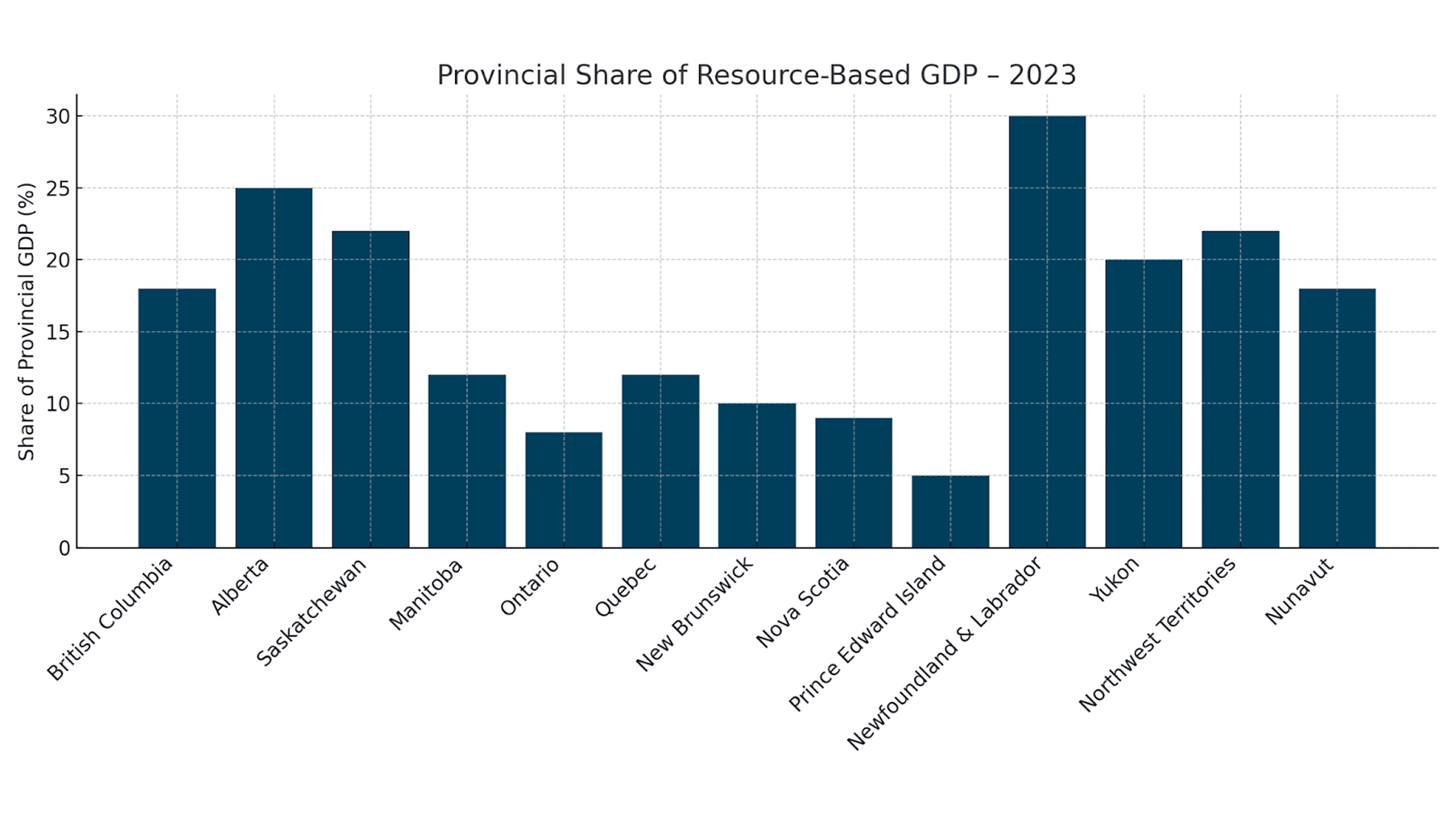
Alberta remains the epicenter of Canada’s hydrocarbon economy (See Figure 2). Oil and gas accounted for nearly 25% of the province’s GDP in 2023, with the oil sands being a cornerstone of the global energy supply.
Newfoundland & Labrador
Offshore oil extraction, particularly in the Jeanne d’Arc Basin,drives a large share of economic activity. However, the province’s dependency on global oil markets renders its economy vulnerable to price volatility.
British Columbia
BC presents a more diversified resource profile, balancing LNG exports, large-scale hydroelectric power through BC Hydro, and an enduring forestry sector.
Data | Resource GDP
Provincial Share of Resource-Based GDP – 2023
Sector | Mining & Minerals
Mining & Minerals: The Extractive Economy
Saskatchewan
A global leader in potash and uranium production. These sectors not only underpin provincial revenues but also support global agricultural and energy systems.
Yukon, Northwest Territories, Nunavut
The northern territories are mineral-rich, with high-value outputs in gold, diamonds, and rare earth elements. These industries represent the backbone of territorial economies, often accounting for over half of GDP.
Quebec
Quebec’s mining sector is pivoting toward critical minerals- nickel, lithium, and cobalt, essential for electric vehicle batteries and renewable energy storage.
Data | Mineral Exports
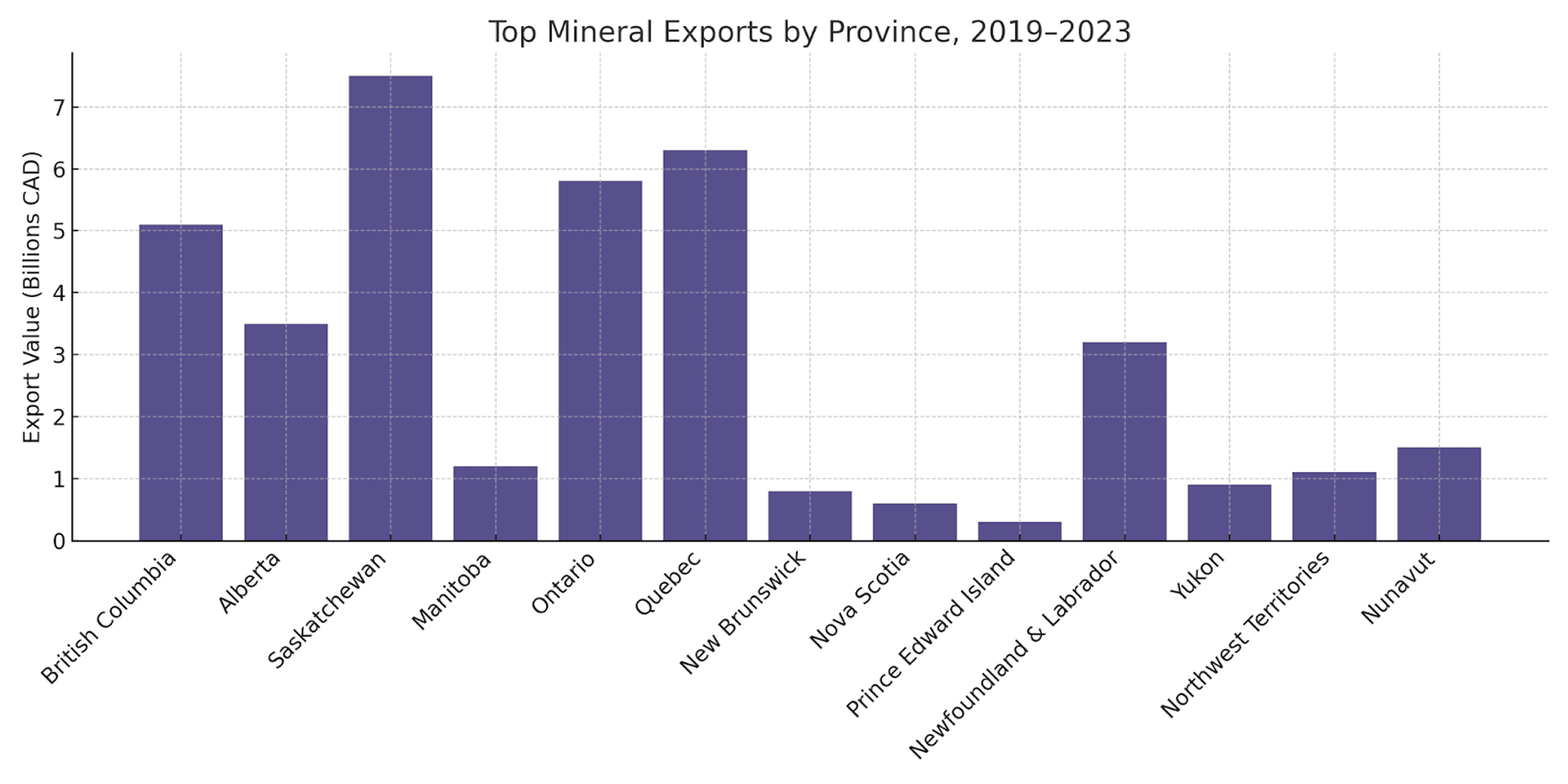
Top Mineral Exports by Province, 2019–2023
Sector | Agriculture & Agri-Food
Agriculture & Agri-Tech: Sustaining Canada and the World
Saskatchewan
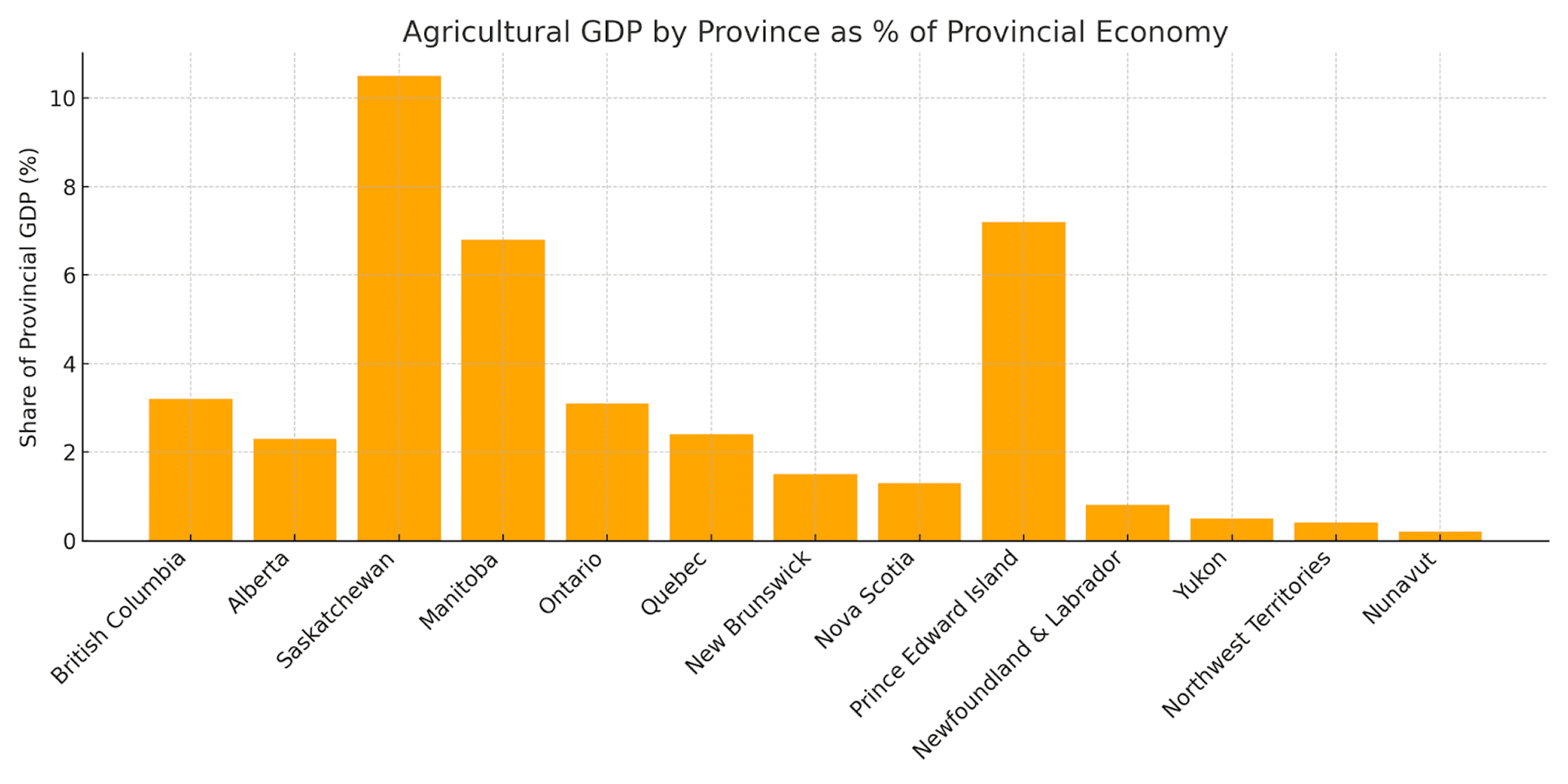
As the country’s breadbasket, Saskatchewan leads in wheat, canola, and lentils. Its agricultural exports are foundational to global food supply chains (See Figure 4).
Manitoba
A leader in hog farming, potato production, and agri-processing. Manitoba also invests significantly in agri-tech and water-efficient farming practices.
Prince Edward Island
Agriculture, particularly potatoes, dominates the island’s economy. PEI continues to modernize through crop rotation research and value-added processing.
Data | Agricultural GDP
Agricultural GDP by Province as % of Provincial Economy
Sector | Services & Innovation
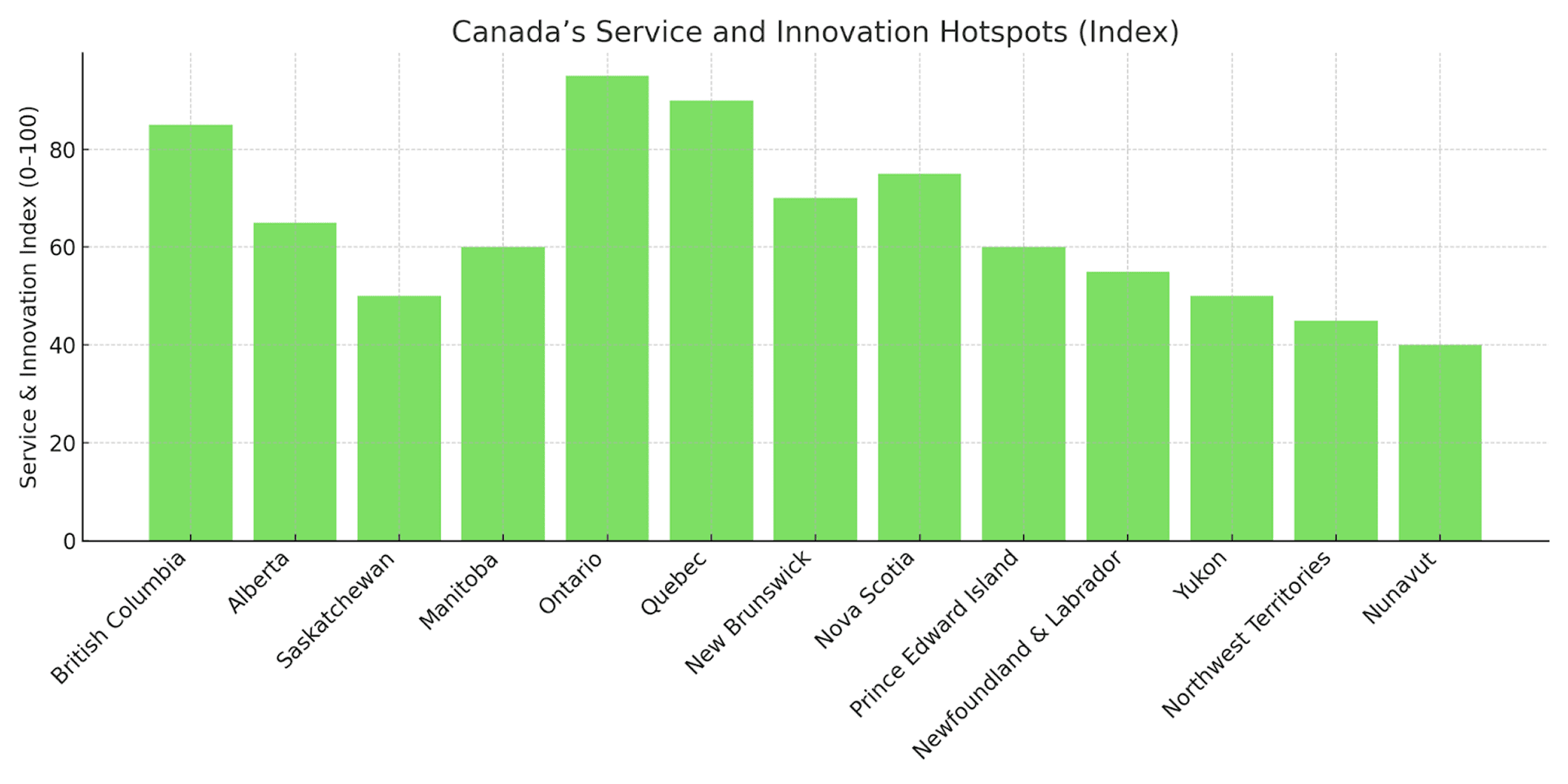
The Service & Innovation Economies: Engines of the Future
Ontario
Home to the country’s financial, technological, and manufacturing hubs. The FIRE sectors (finance, insurance, real estate) drive a substantial share of national GDP.
Quebec
Anchored by aerospace, pharmaceuticals, and AI research. Institutions like MILA and Université de Montréal position Quebec as a global AI leader.
British Columbia
Film production, tourism, and tech startups are central to BC’s growth. Vancouver increasingly competes with Seattle and San Francisco in tech innovation.Nova Scotia & New BrunswickWith aging populations, these provinces are diversifying into marine logistics, post-secondary education exports, and renewables, with some success.
Data | Innovation Index
Canada’s Service and Innovation Hotspots
Trends | Economic Shifts
Intersections and Transitions: Trends Reshaping the Landscape
- Climate Transition: Carbon-intensive economies like Alberta and Saskatchewan must pivot and are investing in carbon capture and clean hydrogen.
- Interprovincial Migration: A tech-oriented workforce is clustering in Ontario and British Columbia, leading to demographic and economic shifts.
- Indigenous Economic Development: Indigenous communities are asserting leadership through co-ownership of resource projects and land stewardship models.
Summary | Key Takeaways
Conclusion: Strength in Complexity
- Canada’s economic identity is not singular-it is a complex interplay of regional sectors, each bringing distinct strengths and vulnerabilities. From Alberta’s oil rigs to Ontario’s fintech towers and Nunavut’s mineral veins, this country’s prosperity depends on recognizing and integrating these diverse engines of growth.
- To lead in an era defined by climate urgency, technological disruption, and geopolitical uncertainty, Canada must double down on regional strengths while supporting national cohesion. The future won’t be driven by one sector or one province; it will be orchestrated by many, moving in concert.
#CanadianEconomy #EconomicDevelopment #ProvincialEconomies #NaturalResourcesCanada #InnovationInIndustry #AgricultureCanada #MiningCanada #CleanTechCanada #SRandED #CheckpointResearch #FutureOfWorkCanada
